
Flow field plates are critical to the fuel cell system, as many of the most important tasks are on their shoulders. They distribute gases, manage the water, and sustain a steady current all at once. TMNetch manufactures high-precision solutions to make the sorting process long-lasting and energy-efficient. Bipolar flow field plates and flow field separator plates are designed to address advanced fuel cell needs while ensuring extended lifespan and efficient operation. What is flow field plate? The article will answer this issue and describe in detail how flow field plates work, what types they have, and where they are used.

What Is Flow Field Plate?
To put it simply, a flow field plate is a component that helps flow the reactant gases, such as hydrogen and oxygen, along the surface of a fuel cell. As is the case with various other components, it helps ensure the uniformity of such flow as well as its efficiency in the areas of catalysts. In simple terms, what is flow field plate? Such a structure is the core of a fuel cell, making sure that everything else functions properly.
Types of Flow Field Plates
There are four major kinds of flow field plates, based on the geometry of their surface structures. Each type has different characteristics in performance, pressure drop, and water management.
1. Parallel Flow Field Plates
These designs have straight, unperturbed channels of low aspect ratio, meaning that the ratio of channel width to height will be close to 1. It is a simple and useful feature that helps minimize energy loss to friction and, thus, pressure drop, making the flow in these structures efficient and with minimal resistance.
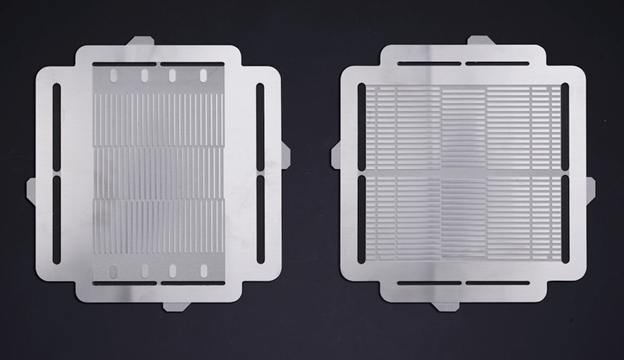
Features:
- Low Pressure Drop: It can allow a continuous, low-energy flow;
- Uniform Flow: The gas can reach the electrodes uniformly, and this can optimize the efficiency of the reaction.
- Simple Manufacturing: Production of the flow field plates using a photochemical etching process is highly efficient.
- Compact Design: Since the use of a flow field plates for portable fuel cell systems enables to be designed more efficiently, the efficiency in these types of systems is high.
Applications: Such a design is most useful when the resistance of the fuel cell needs to be minimized. Its simplicity makes it easy to produce through ordinary methods, such as photochemical etching flow field plates.
Pros:
- Easy to manufacture and maintain.
- Low operational resistance.
Cons:
- Limited water removal capacity makes it flood quickly.
- Low mass transfer efficiency compared to other options.
2. Serpentine Flow Field Plates
Serpentine flow field plates have continuous winding channels that make gases flow extended paths, improving gas mixing and water removal. Therefore, the design maximizes uniformity, creating the optimal conditions for fuel cells.

Features:
- Effective Water Management: Prevents cell flooding, allowing it to run at full capacity.
- Improved Gas Mixing: Improves gas access to the reactant.
- Durability: Bipolar flow field plates made from high-compound materials.
- Heat Dissipation: Spreads temperature to help isothermalize the cell.
Applications: Can be applied frequently for an industrial or automotive PEM system, where bipolar flow field plates for continuous and robust operation are employed.
Pros:
- Excellent gas utilization.
- High water removal.
Cons:
- High pressure drop.
- Energy-intensive for gas circulation.
3. Interdigitated Flow Field Plates
These kinds of flow field separator plates have alternating inlet and outlet channels, which ensure the gases pass through the electrode layer, promoting diffusion and increasing reaction rates. It represents the high-performance fuel cells design that is mainly used in laboratory fuel cells.

Features:
- High Mass Transport: Which increases reactants diffusion through the electrodes.
- Channel Accuracy: Achievable by using photochemical etching flow field plates.
- High power: Suitable for the advanced laboratory fuel cell stack design.
- Optimized Reactant Flow: which minimizes the cell dead zones.
Applications: Mainly used in laboratory cells and fuel cells that require maximum reactant diffusion and flow.
Pros:
- Increases the efficiency and cell performance a lot.
- High gas distribution.
Cons:
- Complicated and expensive to reproduce.
- High precision of fabrication is required.
4. Pin-Type Flow Field Plates
The pin type flow field plates have many small pins or pillars lying in a grid, which promote proper gas guiding. It allows for isotropic flow and is mainly used for cell flexibility applications.

Features:
- Gas Uniform Flow: Promotes equal distribution on all parts of the electrode.
- Improved Water Management: Improves drainage and prevents flooding.
- Customizable Channel Geometry: Ideal option for photochemical etching flow field plates.
- High-stability for experimental applications: Ideal for experimental flow field separator plates applications.
Applications: Flows that require equal and predictable gas and water guidance.
Pros:
- Equal flow parts.
- Compact design.
Cons:
- Difficult to fabricate accurately.
- May cause pressure increase on some cell parts.
Benefits of Flow Field Plates in Fuel Cells
The quality of flow field plates primarily determines the efficiency of fuel cells. The advantages are as follows:
- Superior Gas Distribution: Uniform flows eliminate hotspots, restricting reaction rates.
- Conductivity: Superior dissipation is guaranteed by metallic bipolar flow field plates.
- Lightweight: Flow field plates for portable fuel cells systems, increasing Energy Density.
- Durability: Photochemical etching flow field plates produced by TMNetch do not corrode and degrade.
- Scalability: Different flow field separator plates allow them in a range of fuel cell command plans from small to large. Dozens of other applications are just a few examples.
Other benefits include improved efficiency, longer lifespan, and decreased maintenance work.
Applications of Flow Field Plates
Applications of flow field plates span across numerous industrial and commercial fields:
- Portable Fuel Cells: Used in flow field plates for portable fuel cell, powering electronics or vehicles;
- Hydrogen Energy Systems: Applied to help distribute hydrogen as a clean energy source used for transportation renewal.
- Stationary Power Generation: Large bipolar flow field plates are used in large-volume renewal factories.
- Aerospace and Automotive Industries: The etched plates are predominantly lightweight and are installed in several of the aerospace and automotive industries to increase electric vehicle performance, aircraft flight time, among others.
- Research and Development: The flow field separator plates are used to conduct research and test new available materials and designs in the field cell.
The only trusted producer of the photochemical etching flow field plates in the world is TMNetch.
Why Choose TMNetch for Flow Field Plates?
TMNetch is the industry leader in photochemical etching flow field plates for accuracy, quality, and adaptability.

Key Advantages of TMNetch include:
- Precision: Superior Channel accuracy of advanced photochemical etching flow field plates.
- Material: Stainless steel, titanium, and nickel alloys.
- Custom Design: You can customize an industrial flow field plate or that of portable equipment.
- Delivery: TMNetch has a global network and will always ensure you receive your ordered products in time.
By entrusting your system to TMNetch, you are sure that it has the best flow field plates suitable for long-term application performance.
FAQs
Q1. How do flow field plates function inside the fuel cell?
Flow field plates are perfectly designed to ensure that gases are correctly transferred, the water is completely eliminated by the plate’s smooth surface, and to supply electricity for the portable fuel cell systems.
Q2. How do different designs affect fuel cell performance?
Flow field plate designs determine the intensity and uniformity of gas flow, the optimal pressure distribution in comparison with the electrodes, and the efficiency of water removal from the cell.
Q3. What materials should I use to make flow field plates?
Common materials for the flow field plate production include stainless steel, titanium, and graphite. They are all resistant to corrosion and provide enhanced lifetime in comparison to other common metals.
Q4. How are photochemical etching flow field plates made?
Photochemical etching flow field plates are made through a precise and controlled chemical process that etches the correct patterns in a metal sheet, ensuring that all fuel cell channels are correctly sized and positioned on a flat surface.
Summary
Flow field plates are the central component of the fuel cell system, allowing for the efficient distribution of gas and electricity. TMNetch’s photochemical etching flow plates and bipolar flow field plates guarantee maximal precision and abrasion resistance in all flow field applications, be it industrial processes or portable devices. Making the correct choice in a flow plate separator plates guarantees the most efficient and long-lasting energy performance.